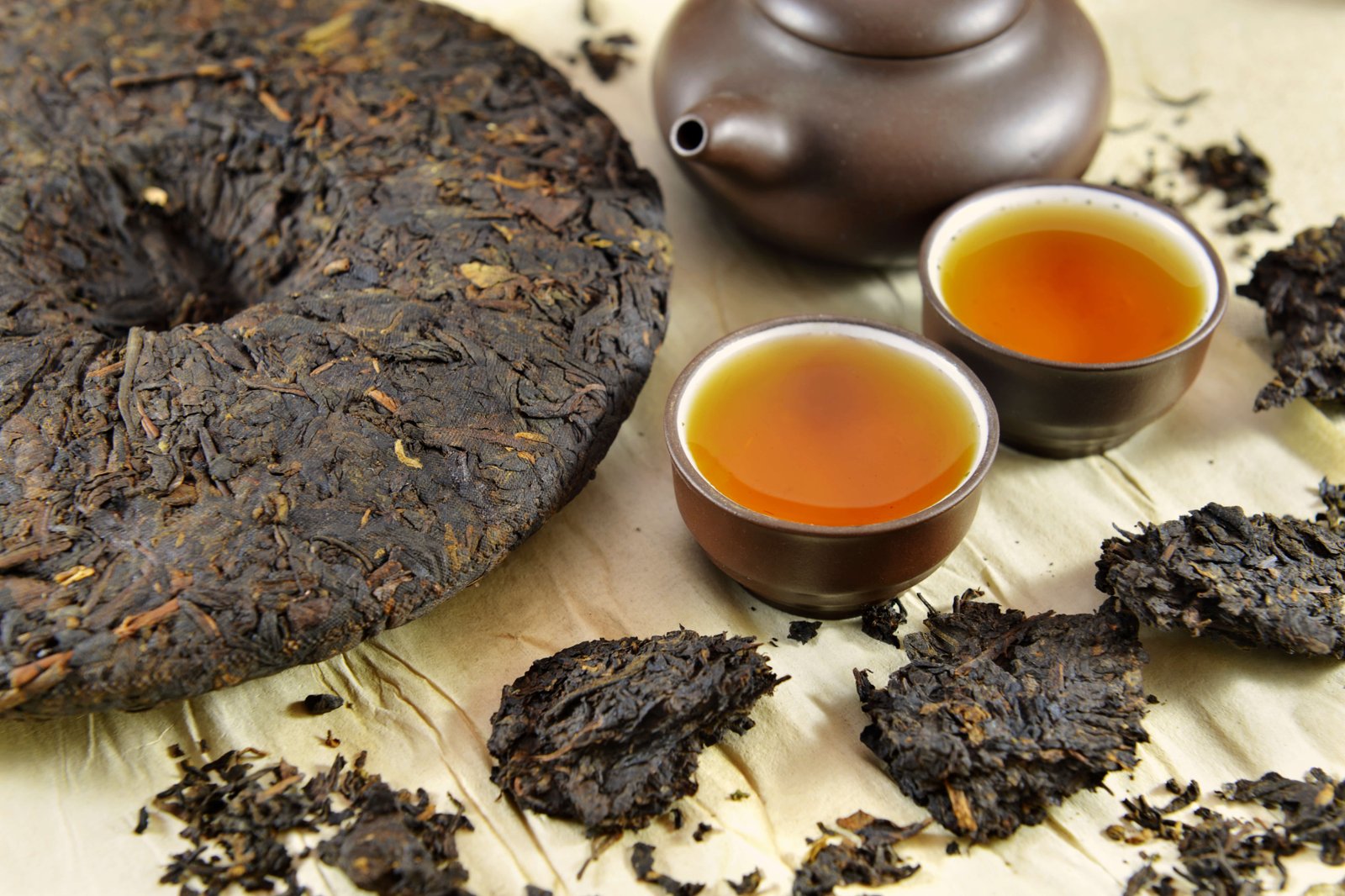
Dark tea began in Yunnan, China, where tea was first pressed into solid shapes to withstand long trade journeys. Traders traveling the Tea Horse Road compressed the leaves to save space during months of travel on horseback and to preseve the tea throughout the journey. Over time, people discovered that these tightly packed teas naturally fermented on the journey, improving in flavour and giving birth to what we now call Pu‑erh tea.
Continue reading to discover the dark‑tea process, the varieties of dark tea, their character, and more.
The steps in producing Dark Tea
Dark tea is set apart from other teas by its post‑fermentation process rather than by oxidaiton.
Among its various sub‑types, Pu‑erh is the most widely known. It takes its name from Pu’er, a county in southern Yunnan Province.
Pu‑erh tea is produced using two primary methods—Sheng (raw) and Shou (ripe)—yet both begin with the same initial stages: withering, pan‑firing, and rolling.
Withering, pan-firing and rolling
Both Pu-Erh start life as a rough green tea, a short wither, either in the sun, or in bad weather conditions, indoors.
The leaves are then pan‑fired to stop most enzymatic activity, preventing oxidation while allowing a few resilient enzymes to remain active.
After heating, the leaves are rolled and lightly kneaded to bruise the leaf structure and release their internal juices. This stage encourages the early development of fermentation and controlled oxidation, which play a key role in shaping the flavour and character of the final Pu-Erh.
After these shared stages, the paths of Sheng and Shoud diverge.
Sheng (Raw) Pu-erh
After rolling, the leaves are dried to remove remaining moisture. Drying stabilises the tea and prepares it for long‑term ageing. The dried leaves are then pressed into compact forms—cakes, bricks, or other traditional shapes—designed to support slow, steady fermentation.
When stored under suitable temperature and humidity, natural microbes and enzymes gradually break down the compounds in the leaves. Over years, this process transforms the tea’s initially sharp, vegetal character into smoother, sweeter, more floral and earthy notes. Well‑stored Sheng Pu‑erh can continue to develop for decades.
Shou (Ripe) Pu-erh
Instead of being dried immediately after rolling, the leaves undergo wet‑piling (wo dui) for several months. This stage promotes microbial activity and accelerates fermentation. By the end of wet‑piling, the tea has already developed much of its mellow, earthy, rounded profile.
Once fermentation is complete, the leaves are dried. They are then lightly steamed to make them pliable, pressed into shape, wrapped, and allowed to age.
Conclusion
Dark tea is defined by its post‑fermentation. While Sheng and Shou Pu‑erh share the same early processing, they diverge in their post-fermentation. Sheng develops slowly through natural ageing, showing flavours that range from greener, herbaceous, fruity, astringent, or bitter when young to woodier, more mineral, rounded, mellow, and smooth as it matures. Shou undergoes an accelerated fermentation that produces an earlier mellow character with the rich, rounded qualities associated with aged Pu‑erh.