
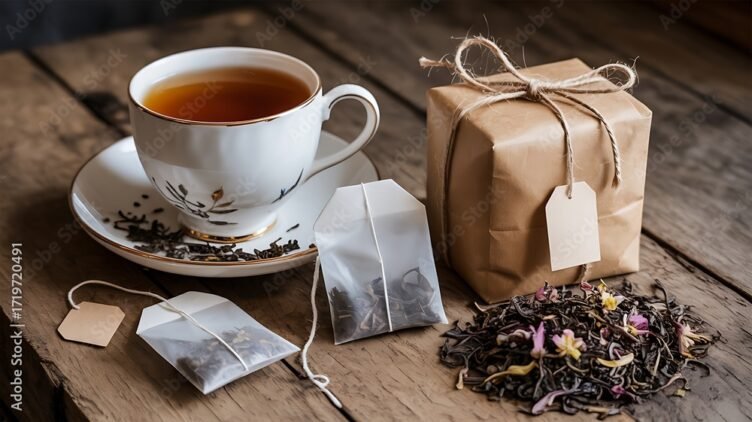
“Since tea bags became popular, the debate between loose‑leaf tea and tea bags has never stopped. Loose leaf is valued for its richer flavour, while tea bags win on convenience. But the real difference goes far beyond that…”
We’ll compare loose-leaf tea and tea bags across 5 key areas: convenience, freshness, flavour, value per cup, and infusion.
Convenience
Brewing loose‑leaf tea requires only a little more effort than using a tea bag, yet the improvement in flavour is remarkable. With simple tools such as a mesh infuser, both brewing and cleaning remain quick and hassle‑free.
Tea bags, by contrast, prioritise speed and simplicity. Their pre‑measured servings require no additional equipment, making them an easy, instant option when convenience is the main concern.
Freshness
Because whole tea leaves have a much lower exposed surface area than CTC leaves or tea bag fannings, they oxidize more slowly and stay fresher for longer when stored correctly.
Commercial tea bags are usually made from very small, lower‑grade tea particles. They brew quickly, but their large exposed surface area causes them to oxidize and lose freshness much faster.
Flavour
High‑quality tea is the result of careful plucking and gentle handling, preserving the tea’s delicate floral notes and volatile flavor compounds.
Whether harvested by hand or with gentle mechanical harvesters and then carefully sorted, this process ensures that only shoots and leaves are used, resulting in a truly exceptional tea.
While it’s a common misconception that all tea bags contain only dust or leftover fragments, most actually hold finely broken tea particles. Because these smaller pieces have a greater surface area, they release tannins more quickly during infusion, often producing a bitter, more astringent brew.
Value
You might be thinking that loose‑leaf tea must be more expensive per cup than tea bags, but that isn’t always true.
Loose‑leaf tea requires only a small amount of leaves, many of which can be infused multiple times, significantly reducing the cost per cup. Tea bags, by contrast, may seem cheaper at first glance, but each bag is designed for a single infusion. When you compare cup for cup, their cost is often surprisingly similar to that of loose‑leaf tea.
What truly sets loose‑leaf tea apart, however, is what happens beyond the first cup. With each subsequent infusion, the leaves gradually reveal new layers of flavour and aroma, transforming the experience and offering something slightly different every time you brew.
Infusion
Finely chopped leaves, such as those commonly found in tea bags, release high levels of heavy tannins during brewing. These tannins create a bitter, more astringent cup, often prompting the addition of milk, sugar, or lemon to soften the taste.
A truly good tea, much like a fine wine, is best appreciated on its own, when nothing is added.
Loose‑leaf tea offers another important advantage, it can be brewed exactly to your taste.
Final thoughs
While the quality of some tea bags has improved, with many now containing whole loose‑leaf tea, they are often significantly more expensive than loose leaf, restrict the natural movement of the leaves needed to brew a truly good cup of tea, and hide the contents, making it difficult to judge freshness and quality.
The choice ultimately comes down to personal preference. If convenience leads you to choose tea bags, opt for pyramid bags made with whole loose‑leaf tea and biodegradable, polypropylene‑free materials. Otherwise, our guide can help you choose high‑quality loose‑leaf tea for the best possible brewing experience.